

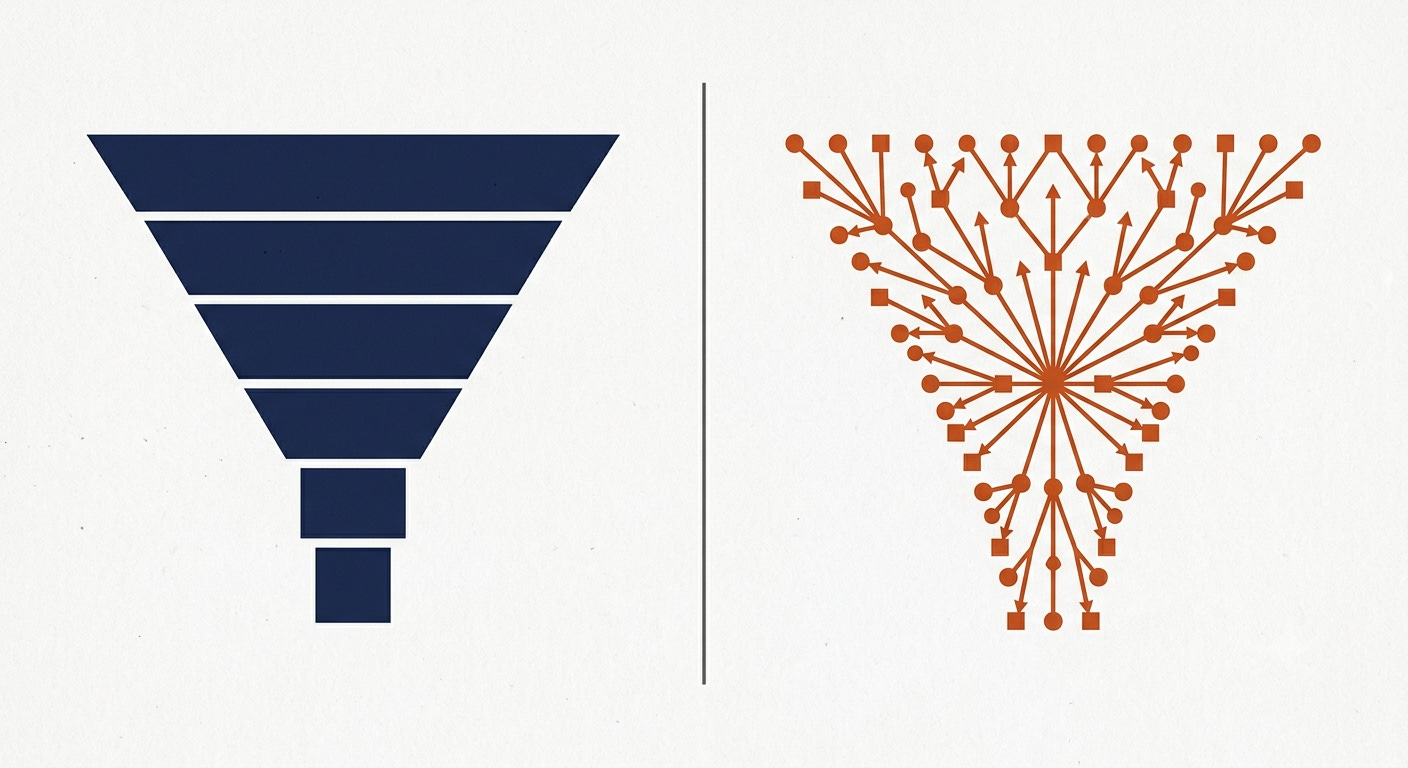
This is really a new version of an old problem. But one that could previously be compartmentalised, but now certainly cannot. Your marketing and sales teams used to be able to sit in silos whilst your product and engineering are the delivery and execution people here to just “make stuff work”.
Yet every time I am engaged for solving operational issues, the issue isn’t fundamentally an operational problem. What all businesses want, all of them, is growth. Revenues, big margins, because if they have that they are not as concerned about operating costs very often. The most common scenario I see is that business leaders are distracted by operating costs and issues through lack of visibility and simple inability to identify, measure and enable growth.
We can make your engineering team more efficient, we can make your operating model repeatable, we can add automation to the customer life cycle so its fully self service. None of these are growth vectors. Its difficult to grow if they are not efficient, but they are not the mechanism to enable sales, or high LTV.
There is a persistent myth in B2B SaaS that the best product wins.
It is a comfortable myth, particularly for founders with an engineering or product background. It keeps the focus on what they are best at and defers the harder question: once you have built something good, how does anyone find out about it, understand why it is the right choice, and actually buy it?
The honest answer, in most cases, is: not efficiently, and not at scale.
Distribution is the most undervalued growth lever in B2B software. Not because founders don’t know it matters, but because they consistently underinvest in it relative to product — and because the frameworks most founders use to think about distribution are ten years out of date.
The product bias problem
Early-stage software companies almost always have a product bias. The founding team is usually product or engineering-led. The first hires are developers. The board updates lead with roadmap progress and feature releases. The implicit assumption is that if the product is good enough, growth will just follow.
To take an example.. Google Wave. Launched in 2009, it was technically sophisticated — a real-time collaborative workspace that combined email, messaging, and document editing years before those ideas became mainstream. It was also completely misunderstood by buyers, who couldn’t place it in any familiar category or articulate why they needed it. Google shut it down after eighteen months. The product wasn’t the problem. The distribution and positioning were. The features that eventually went into Google Wave became the foundations of Slack and Notion — both of which spent significant effort on making their value proposition legible before they spent on growth.
In most large B2B Enterprise categories, buyers are not actively scanning the market for the best solution. They are looking for a solution that is good enough, from a vendor they already know or have been referred to, that can be bought without excessive internal friction. The incumbent wins not because it is better, but because switching requires effort and the status quo requires none.
Breaking into that dynamic is a distribution problem, not a product problem.
What distribution actually means
Distribution in B2B SaaS and AI led Product Companies is not the same thing as sales. It is the entire system by which a product reaches its buyers — the channels, the motion, the partnerships, the content, the community, and the positioning that frames the product in the buyer’s mind before the first sales conversation takes place.
Atlassian built a business worth over $50 billion with almost no traditional sales organisation for the first decade of its existence. Its distribution model was product-led: developers adopted Jira and Confluence within their teams, usage spread organically across organisations, and the commercial relationship followed usage rather than preceding it. The product was good — but the distribution insight was that developers, not procurement teams, were the real buyers, and that the path to the enterprise ran through the individual contributor.
HubSpot took a different approach. Rather than selling marketing software, they created and popularised the concept of inbound marketing, built an entire content and certification ecosystem around it, and used that ecosystem as their primary distribution channel. They grew by teaching their methodology — and their software was the natural tool for implementing it. The distribution motion and the product were inseparable.
Both of these are examples of companies that made explicit, deliberate choices about how their product would reach the market. That is what distribution strategy looks like when it is taken seriously.
Positioning is a growth lever, not a marketing exercise
Most software companies treat positioning as a branding problem. They spend time on messaging documents, taglines, and website copy. What they produce is a description of what the product does. This is not positioning.
Positioning, in the sense that actually drives commercial outcomes, is the answer to a specific question in the buyer’s mind: why this, why now, why not the alternative I’m already using?
Veeva Systems is the clearest illustration of this in enterprise software. When they entered the life sciences market in 2007, they were competing against Salesforce — which already had a CRM product that pharmaceutical companies were using. Rather than competing on features, Veeva positioned exclusively for pharmaceutical and biotech companies, built every element of the product around the regulatory and compliance requirements specific to that industry, and refused to serve adjacent verticals. The positioning was so narrow that it felt like a risk. It turned out to be the moat. Veeva went public in 2013 and reached a $40 billion market capitalisation.
Gong is a more recent example. The product records and transcribes sales calls — a capability that several competitors also offered. What Gong did differently was reframe the category. Instead of positioning as call recording software (bought by IT, low price, commodity), they positioned as revenue intelligence (bought by CROs, higher price, strategic). The same underlying capability, reframed for a different buyer with a different business problem, at a meaningfully higher price point.
Bad positioning tries to be relevant to everyone. It produces generic messaging that resonates with nobody and loses to specialists in every vertical it competes in. Good positioning narrows deliberately, names the customer precisely, and makes a specific, testable claim about what success looks like.
That degree of specificity feels uncomfortable. It also converts.
How AI is changing the distribution landscape
The B2B SaaS distribution model that most founders are working from was built for a world where buyers discovered products through Google search, analyst reports, peer review sites like G2, and direct sales outreach.
That world is changing faster than most GTM strategies are adapting.
Buyers are now using AI to research and shortlist. A growing proportion of B2B buyers begin their evaluation process with an AI-generated overview — asking a model to summarise the options in a category, explain the trade-offs, and suggest vendors worth evaluating. If your product does not appear in those answers, you are invisible to a segment of the market that is growing rapidly. This is not an SEO problem. It is a content and positioning problem. The way to show up in AI-generated research is to publish specific, well-sourced, authoritative content that clearly defines the problem you solve, the category you operate in, and the evidence that your product works. Broad positioning and vague messaging will not surface. Precise positioning with documented outcomes will.
AI-powered GTM tools are compressing outbound economics. Platforms like Clay have changed the economics of personalised outbound at scale. What previously required a team of SDRs researching accounts, personalising outreach, and managing sequences can now be done by a much smaller team using AI-powered research and automation. The cost advantage has shifted. The competitive differentiator in outbound is no longer headcount — it is targeting precision. Founders who have not done the positioning work to define their ideal customer profile with real specificity will find that AI-powered outbound amplifies their irrelevance, not their reach.
Vertical AI businesses are building new distribution models from scratch. Harvey, the AI legal assistant, has reached a valuation of over $3 billion by doing something that most AI businesses avoid: committing to a single vertical. Harvey is not an AI productivity tool for knowledge workers. It is AI for lawyers — trained on legal reasoning, integrated into legal workflows, and sold to law firms and in-house legal teams. The specificity of the positioning is the distribution advantage. It determines which conferences to attend, which publications to feature in, which partners to build, and which customer success stories to tell. Everything compounds because everything is aimed at the same buyer. Abridge has done the equivalent in clinical documentation for healthcare. Cursor has done it for developer tooling. Each of these businesses has won early traction not by being the most capable AI model in absolute terms, but by being the most precisely positioned product for a specific job that a specific buyer needs to get done.
What this means for founders and investors
For founders, the implication is straightforward, if uncomfortable: distribution strategy deserves the same rigour as product strategy. That means making explicit choices about channels, motion, and ideal customer profile — and treating those choices as strategic, not operational.
It also means doing the positioning work before you need it. Most founders revisit positioning after growth stalls. Monday.com is often cited as a product success story, but its real competitive advantage over Asana and Basecamp was a deliberate decision to position for non-technical business teams — and then to spend aggressively on distribution to that specific audience. The positioning decision came first. The growth followed.
For investors, the distribution question is one of the most reliable signals of business quality at early stage. A portco that can clearly articulate who its customer is, how they find out about the product, what makes it the obvious choice over alternatives, and what the unit economics of customer acquisition look like — that is a business with a foundation for growth. One that cannot answer those questions clearly, regardless of how good the product is, has a distribution problem that will eventually show up in the numbers.
AI enabled an entirely new landscape
Search is now split between the model providers and the traditional search engines and its entirely different search terms that users are looking to answer questions. This is enabling a level of autonomous integration with abilities to trigger connectivity to solutions and services which previously had barriers to engagement.
Take APIs often behind walled gardens, as providers need to ensure security, payments and limitations on consumption. Well you have to find out if the provider has API services to integrate with, do they have all the fields you need to build the integration what sort of service is offered? Are there throttling limits which would put a cap on the number of transactions per day? What is the commercial value for you? What is the commercial value for the other party?
Or lets consider middleware providers, the newer crop like n8n or the older providers like Mulesoft and Zapier who promised a lot of value but so often hit a wall of limited value with only 70-80% (if you were lucky) of the automation you need supported by their existing service whilst the rest is a bespoke build that you have to both work out, and then implement and maintain. For industries with complex toolchains, who rely on any number of point based solutions this is really a pain point.
There is no doubt that agentic solutions not only put more power at the fingertips of naive users without a lot of software development knowledge. They also mean that a search based recommendation can quickly be a test demo and an ongoing subscription/revenue for a provider that solves this for the user. Influencing at the point of sale and use in that way for enterprise businesses is very new.
It needs an entirely new and fully integrated approach to marketing, user engagement, technical product and automation.
Distribution trumps product utility
Most growth stage software companies struggle with product teams and leadership myopically focused on adding utility to an existing product. They lack the ability to articulate strategy and attach product development to growth.
The best product does not always win. The best-distributed product, built for a specific buyer, positioned to solve a specific problem, and sold through a motion that fits the way that buyer actually buys — that is what wins.
Distribution is not a function. It is the strategy.
Interesting framing. I’m wondering whether “distribution” is doing quite a lot of work here, because once positioning, channels, partnerships, content and buying motion all sit inside it, it starts to look less like one growth lever and more like the wider GTM system.